NEET Re-Exam 2026: 48-Hour Revision Plan, Most Important Chapters & Final Exam-Day Strategy
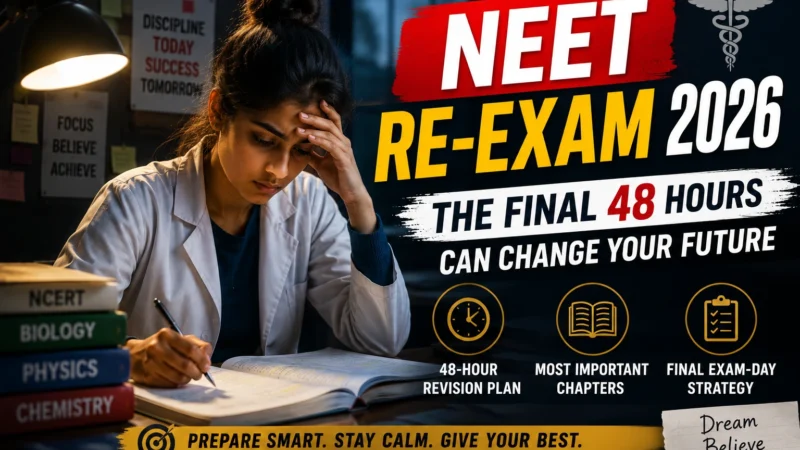
NEET Re-Exam 2026 is now just days away, making the final 48 hours extremely important for every medical aspirant. Instead of studying new topics, students should focus on smart revision, high-weightage chapters, NCERT concepts, and exam-day strategy. In this article, we’ll cover the most important topics to revise, a practical 48-hour revision plan, and expert tips to help you perform your best in the NEET Re-Exam 2026.
Why the 48-Hour Window Is More Powerful Than You Think
Most students waste their last 48 hours in one of two ways: they either try to read everything from scratch (impossible and counterproductive), or they collapse into anxiety and barely study at all (equally destructive).
The truth? Forty-eight hours is the perfect window for consolidation, not cramming. Your brain has already absorbed months of information. What it needs now is activation — pulling those memories to the surface, reinforcing the connections, and eliminating confusion from weak spots.
Research in cognitive science is clear: spaced repetition and active recall in the final 48 hours can improve performance by 15–25% compared to students who either cram or rest entirely. The students who crack NEET in re-attempts aren’t always the ones who studied the most — they’re the ones who revised the smartest in the last two days.
So let’s get into it.
Part 1: The NEET 2026 Re-Exam — What You’re Actually Facing
Before we talk strategy, let’s be honest about the battlefield.
NEET 2026 tests 720 marks across three subjects:
- Biology (Botany + Zoology): 360 marks — the king of NEET, and your biggest opportunity
- Physics: 180 marks — the most feared, but also the most formula-predictable
- Chemistry: 180 marks — split between Organic, Inorganic, and Physical, each with its own personality
The re-exam format remains the same: 200 questions (180 to attempt), MCQ-based, with +4 for correct and –1 for wrong. That negative marking is everything. A student who attempts 160 questions with 85% accuracy will outscore someone who attempts 185 with 70% accuracy. Every single time.
Keep that in your head throughout these 48 hours.
Part 2: The Most Important Chapters for NEET 2026 (Subject-Wise)
This is where most revision guides fail you — they list every chapter as “important.” That’s useless. Here’s what the actual data from NEET previous years (2019–2025) tells us about where the marks really come from.
🌿 BIOLOGY — Your 360-Mark Foundation
Biology is non-negotiable. It’s nearly 50% of your paper. A score of 320+ in Biology with average Physics and Chemistry will still get you into a good medical college. Ignore Biology’s depth at your own peril.
Botany: The High-Yield Chapters
1. Plant Kingdom Every single year, 3–5 questions come from Plant Kingdom. Algae (their pigments, reserve food, cell wall), Bryophytes, Pteridophytes, Gymnosperms, Angiosperms — their classification, alternation of generations, and economic importance. Don’t skip the NCERT boxes and footnotes here. Examiners love those.
2. Morphology of Flowering Plants Root modifications, stem modifications, leaf modifications, types of inflorescences, floral formula of Fabaceae, Solanaceae, Liliaceae — these appear almost every year. Draw the diagrams in your head. Know them cold.
3. Anatomy of Flowering Plants Dicot vs Monocot root, stem, and leaf anatomy. The Casparian strip. Secondary growth. Bundle sheath cells. This chapter consistently delivers 2–3 questions with straightforward, direct answers.
4. Cell: The Unit of Life Cell organelles, fluid mosaic model, differences between prokaryotic and eukaryotic cells, types of chromosomes — this chapter is a gift because the answers are black and white. Every mark here is earnable.
5. Photosynthesis in Higher Plants C3 vs C4 plants, Calvin cycle intermediates, photorespiration, PS I and PS II, Z-scheme — this is a conceptual chapter that rewards students who genuinely understand the mechanism rather than memorizing points.
6. Respiration in Plants Glycolysis, Krebs cycle, ETS, oxidative phosphorylation, RQ values for different substrates — 2–3 marks almost guaranteed. Know your ATP yields cold: net 36–38 ATP per glucose.
7. Plant Growth and Development Phytohormones (especially Auxin, Gibberellin, Cytokinin, ABA, Ethylene), seed dormancy, photoperiodism, vernalization — NCERT one-liners here are gold. Read the chapter’s summary twice.
Zoology: The High-Yield Chapters
1. Human Reproduction Spermatogenesis vs Oogenesis (diagrams are key), menstrual cycle hormones and their timelines, fertilization, implantation, placenta functions, parturition — this is one of the most consistent 4–6 question chapters in NEET history. Know every stage.
2. Reproductive Health Contraceptive methods, STDs, MTP Act, ZIFT, GIFT, IUF, amniocentesis — NCERT definitions matter here. It’s easy marks if you’ve read the chapter carefully.
3. Principles of Inheritance and Variation Mendel’s laws, codominance, incomplete dominance, sex-linked inheritance (haemophilia, colour blindness), chromosomal disorders (Down’s, Turner’s, Klinefelter’s), pedigree analysis — expect 4–6 questions. Pedigree analysis is particularly high-value right now.
4. Molecular Basis of Inheritance DNA structure (Chargaff’s rules, Watson-Crick model), replication, transcription, translation, genetic code properties, lac operon, Human Genome Project — 5–7 questions easily. This chapter demands full attention.
5. Evolution Miller-Urey experiment, Darwin’s theory, types of natural selection, Hardy-Weinberg principle (and its violations), adaptive radiation, examples of evolution — 3–4 questions that are almost always from NCERT’s own text.
6. Human Health and Disease Types of immunity, vaccines, cancer (oncogenes, carcinogens), common diseases (Malaria, Typhoid, Pneumonia, Amoebiasis, Ascariasis), AIDS — 4–6 questions with highly specific, factual answers. The parasite names, their hosts, vectors — get these right.
7. Biotechnology and Its Applications Recombinant DNA technology, restriction enzymes (their naming convention), gel electrophoresis, PCR, transgenic animals, Bt crops, Golden Rice, ELISA, RNAi — 4–6 questions. This is the future of NEET Biology and examiners know it.
8. Ecology and Environment Ecosystem structure, productivity (GPP vs NPP), food chains, ecological pyramids, nutrient cycles (Carbon and Phosphorus especially), biodiversity, conservation strategies, environmental issues — 8–10 questions. Do NOT underestimate Ecology. Students who master this chapter consistently add 30–40 marks.
⚗️ CHEMISTRY — The 180-Mark Balancing Act
Chemistry is unique because it has three very different personalities within one subject. Your 48-hour strategy must treat them differently.
Physical Chemistry: Formula-Dependent, High Accuracy Possible
1. Some Basic Concepts of Chemistry Mole concept, concentration terms, stoichiometry — 1–2 questions, but they’re calculation-based. Know your formula sheet cold.
2. Thermodynamics First, second, third laws, Hess’s law, bond enthalpy, entropy, Gibbs free energy, spontaneity — 2–3 questions. Conceptual clarity matters more than memorization here.
3. Equilibrium Le Chatelier’s principle, equilibrium constants (Kp and Kc), ionic equilibrium, pH calculations, buffer solutions, solubility product — 3–4 questions. Practice calculations.
4. Electrochemistry Nernst equation, EMF calculations, conductance, electrolysis (Faraday’s laws), fuel cells, corrosion — 2–3 questions that are calculation-heavy. Know the formula and the units.
5. Chemical Kinetics Rate laws, rate constants, integrated rate equations, Arrhenius equation, activation energy — 2 questions almost always. The half-life formulas for zero, first, and second order reactions are essential.
Inorganic Chemistry: Memory-Based, NCERT is Everything
1. The p-Block Elements Group 15, 16, 17, 18 — structures, allotropes, compounds (oxyacids especially), anomalous behaviour, properties of noble gases — 4–6 questions. This is pure NCERT. If it’s in NCERT, it can be asked.
2. The d and f-Block Elements Variable oxidation states, colour, catalytic properties, interstitial compounds, complex ions, lanthanide contraction, actinides — 2–3 questions. The trend-based questions here are predictable.
3. Coordination Compounds Ligands, IUPAC nomenclature, types of isomerism (especially optical and geometric), VBT, CFT basics, EAN rule — 2–3 questions. Nomenclature practice is essential.
Organic Chemistry: Concept-Heavy, High Reward
1. General Organic Chemistry Inductive effect, mesomeric effect, hyperconjugation, carbocation stability, carbanion stability, intermediates — the foundation of all Organic Chemistry. Get this right and everything else becomes easier.
2. Haloalkanes and Haloarenes SN1 vs SN2 mechanisms, stereochemistry of reactions, elimination reactions, nucleophilicity trends — 2–3 questions with predictable patterns.
3. Alcohols, Phenols, and Ethers Reactions of alcohols (Lucas test, esterification, oxidation), phenols (acidic nature, reactions), Williamson synthesis — 2–3 questions.
4. Aldehydes, Ketones, and Carboxylic Acids Nucleophilic addition, Aldol condensation, Cannizzaro reaction, reactions of carboxylic acids, acidity comparison — 3–4 questions. This is one of the richest chapters in Organic.
5. Biomolecules Carbohydrates (reducing/non-reducing sugars, anomers, mutarotation), proteins (primary/secondary/tertiary/quaternary structure, denaturation), nucleic acids, vitamins, hormones — 3–4 questions, and extremely NCERT-friendly.
6. Polymers and Chemistry in Everyday Life Types of polymers, specific polymers and their monomers, drugs and their classification — 2–3 questions of pure memory. Spend 30 minutes here and you will not regret it.
🔭 PHYSICS — The 180-Mark Challenge
Physics is where NEET aspirants often lose marks they shouldn’t. The questions are formula-based but trick-heavy. In your 48 hours, focus on high-yield, high-frequency chapters and avoid going deep into derivations.
1. Laws of Motion Newton’s laws, free body diagrams, friction (static vs kinetic), circular motion — 2–3 questions. Concept-based, not heavily mathematical.
2. Work, Energy, and Power Work-energy theorem, conservation of energy, elastic and inelastic collisions, power — 2–3 questions with standard problem types.
3. Rotational Motion Moment of inertia, torque, angular momentum, rolling without slipping — 2–3 questions. Know the standard MI formulas for common shapes (disk, ring, sphere, rod).
4. Gravitation Kepler’s laws, gravitational potential, escape velocity, orbital velocity, satellites — 1–2 questions, but they’re almost always formula applications.
5. Thermodynamics Isothermal, adiabatic, isochoric, isobaric processes, Carnot engine efficiency, laws of thermodynamics — 2–3 questions. Know the PV diagrams.
6. Waves and Sound Simple harmonic motion (equations, velocity, acceleration), standing waves, beats, Doppler effect — 3–4 questions. SHM is particularly high-yield.
7. Ray Optics Mirror formula, lens formula, lens maker’s equation, prism dispersion, total internal reflection, optical instruments — 3–4 questions. Draw the diagrams to solve — don’t try to do these purely algebraically.
8. Wave Optics Young’s double-slit experiment (fringe width formula), diffraction, polarization, interference — 2–3 questions. Know YDSE cold.
9. Electrostatics Coulomb’s law, electric field and potential, Gauss’s law, capacitors (series/parallel), energy stored — 3–4 questions. Capacitor combinations are perennial favourites.
10. Current Electricity Ohm’s law, Kirchhoff’s laws, Wheatstone bridge, potentiometer, meter bridge — 3–4 questions. Numerical problems here are straightforward if you practice.
11. Magnetism and Moving Charges Biot-Savart law, Ampere’s law, magnetic force on current-carrying conductors, cyclotron — 2–3 questions.
12. Electromagnetic Induction and Alternating Current Faraday’s laws, Lenz’s law, self and mutual inductance, AC circuits (LCR), resonance, transformer — 3–4 questions. Know impedance formulas.
13. Modern Physics Photoelectric effect (Einstein’s equation), de Broglie wavelength, Bohr’s model, radioactive decay (half-life calculations), nuclear reactions — 4–5 questions. This is one of the highest-frequency chapters in NEET Physics. Do not skip it.
14. Semiconductor Electronics p-n junction, forward/reverse bias, logic gates (truth tables), transistors — 2–3 questions with standard, predictable MCQ patterns.
Part 3: The 48-Hour Battle Plan — Hour by Hour
Here’s the non-negotiable structure. Follow this with military discipline.
Day 1 (48 to 24 Hours Before Exam)
Hour 1–2 | Morning: Assessment and Setup
Before you touch a single book, do this: take a blank sheet of paper and list every chapter from all three subjects. Mark each one: Green (strong), Yellow (shaky), Red (weak). This 30-minute assessment will save you 6 hours of wasted revision on chapters you already know.
Your 48-hour focus must be: Yellow chapters first, then Green chapter quick reviews, and Red chapters — pick only the easiest topics within them. Never spend your final 48 hours trying to learn something from scratch.
Set up your study space: phone on Do Not Disturb, snacks within reach (avoid heavy meals that cause drowsiness), water bottle full, good lighting. Your environment is your performance enhancer.
Hour 3–6 | Biology: Ecology + Genetics
Start with Biology’s highest-yield sections. Ecology and Genetics together can give you 10–14 marks.
- Read Ecology chapters: Organisms and Populations, Ecosystem, Biodiversity — focus on definitions, key terms, examples (endemic species, hotspots, in-situ vs ex-situ conservation)
- Switch to Genetics: Molecular Basis of Inheritance — DNA structure, replication enzymes (Helicase, Primase, DNA Pol III, DNA Pol I, Ligase), transcription, translation, genetic code properties
- Make a quick one-page cheat sheet of key facts from each
Hour 7–9 | Chemistry: Organic Chemistry Reactions
- Cover Aldehydes, Ketones, Carboxylic Acids — write out the named reactions (Aldol, Cannizzaro, Clemmensen, Wolff-Kishner, Hell-Volhard-Zelinsky)
- Revise Haloalkanes: SN1 vs SN2 conditions
- Biomolecules: Go through NCERT summary for carbohydrates and proteins
Hour 10–12 | Physics: Modern Physics + Electrostatics
- Solve 10–15 Photoelectric effect problems — use Einstein’s equation until it’s automatic
- Radioactive decay: Practice 4–5 half-life calculations
- Electrostatics: Revise capacitor combination problems
Hour 13 | Lunch Break + Power Nap
Eat a proper meal. Take a 20-minute nap. This is not optional — it’s strategic. Sleep consolidates memory. Skipping this is trading 3 marks for the illusion of productivity.
Hour 14–17 | Biology: Human Reproduction + Biotechnology
- Human Reproduction: Draw the spermatogenesis and oogenesis diagrams from memory. Write out the menstrual cycle hormone timeline
- Human Health and Disease: Diseases, their causative agents, vectors, and symptoms — make a table
- Biotechnology: Restriction enzymes, PCR steps, gel electrophoresis, Bt crops mechanism, Golden Rice
Hour 18–20 | Chemistry: Inorganic — p-Block + Coordination
- p-Block: Oxyacids of Nitrogen and Sulphur (structures are critical), anomalous behavior of first members, interhalogen compounds
- Coordination: IUPAC naming practice, Werner’s theory, types of isomerism
- d-Block: Variable oxidation states, colour, KMnO4 and K2Cr2O7 reactions
Hour 21–23 | Physics: Current Electricity + Waves
- Kirchhoff’s laws problems (2–3 standard circuit problems)
- SHM: Write out all equations — displacement, velocity, acceleration, energy
- Doppler effect formula — both approaching and receding
Hour 24 | End of Day 1: Revision + Sleep
Spend 30 minutes reviewing your cheat sheets from the day. Then sleep for 7–8 hours. This is non-negotiable. Sleep deprivation reduces exam performance by 20–30% — that’s 40–50 marks you’re throwing away.
Day 2 (24 to 0 Hours Before Exam)
Hour 25–27 | Morning: Biology Quick Review
- Plant Kingdom: Algae pigments, Bryophyte life cycle alternation, differences between Moss and Fern
- Morphology: Floral formulas, root modifications, stem modifications
- Evolution: Hardy-Weinberg principle, types of selection, key examples
Hour 28–30 | Chemistry: Physical Chemistry Formulas
- Write out every key formula from Thermodynamics, Electrochemistry, Kinetics on one sheet
- Solve 3–4 problems each from Nernst equation and rate law calculations
- Equilibrium: pH calculation practice for weak acids and buffers
Hour 31–33 | Physics: Optics + Electromagnetic Induction
- Mirror and lens formula practice: 5 problems each
- YDSE: Fringe width formula, conditions for bright and dark fringes
- LCR circuits: Impedance, resonance condition, power factor
Hour 34 | Afternoon: One Full Mock Section
Take one subject — preferably Biology — and attempt a 90-question mock (or a 45-question half-mock). Time yourself. Then spend 30 minutes reviewing only the questions you got wrong. This activates your mistake-recognition pattern before the actual exam.
Hour 35–37 | Final Biology Sweep
- Respiration: ATP production chart (glycolysis = 2 ATP, Krebs = 2 ATP, ETS = 32–34 ATP)
- Anatomy of Flowering Plants: Draw dicot and monocot cross-sections mentally
- Reproductive Health: Go through the contraceptive methods table
Hour 38–40 | Final Chemistry Sweep
- Polymers: Memorize monomer-polymer pairs (Buna-N, Buna-S, Neoprene, Nylon, Teflon, Bakelite)
- Chemistry in Everyday Life: Drug classification (analgesics, antibiotics, antiseptics — key examples)
- NCERT exemplar: Flip through 15–20 random questions for pattern recognition
Hour 41–43 | Final Physics Sweep
- Semiconductor: Draw and know all logic gate truth tables
- Rotational motion: Standard MI values — disk ½MR², ring MR², sphere 2/5 MR², rod 1/12 ML²
- Gravitation: Escape velocity and orbital velocity derivation — not derivation, just the final formula and its meaning
Hour 44–45 | Pack and Prepare
Stop studying. Seriously. The learning is done. Now prepare:
- Admit card printed ✓
- Valid photo ID (Aadhaar, Passport, or Voter ID) ✓
- Two passport-size photographs ✓
- Blue/black ballpoint pens (minimum 2) ✓
- Wristwatch (digital or analog — phones are not allowed) ✓
- Water bottle and approved snacks if allowed ✓
- Know your exam center’s exact location and route — plan to arrive 45 minutes early ✓
Hour 46–48 | Rest, Light Revision, Sleep Early
Go through only your one-page cheat sheets. Do not open new chapters. Do not attempt new problems. Watch something light, talk to a friend, take a walk. Sleep by 10 PM if your exam is at 2 PM. Your body needs 7–8 hours. This is your last performance optimization.
Part 4: Exam Day Strategy — The Hour That Separates Toppers
You’ve made it to exam day. Here’s how to make every second count.
Morning Ritual (3–4 Hours Before Exam)
Wake up naturally or with a gentle alarm — not a jarring one. Eat a medium, easily digestible breakfast: rice, curd, fruits, or idli/upma. Avoid heavy parathas, fried food, or anything that makes you feel sluggish. Drink water. Take a quick shower. These physical cues signal to your brain that it’s performance time.
Read your formula cheat sheet one final time — not for new learning, but for activation. You’re warming up the engine, not adding new fuel.
The First 15 Minutes Inside the Hall
When you sit down, breathe. Take three slow, deep breaths. This is neurologically proven to reduce cortisol levels and activate your prefrontal cortex — the part of the brain that solves problems.
Read the instructions even though you know them. This 2-minute ritual settles your nervous system.
The Three-Round Strategy
Round 1 (First 90 minutes): Go through all 200 questions. Answer everything you know with high confidence immediately. Skip anything that makes you pause. Mark it and move on. This builds momentum and ensures you don’t waste time on hard questions at the cost of easy ones.
Round 2 (Next 45 minutes): Return to skipped questions. Now spend 60–90 seconds on each. Use elimination — even if you don’t know the answer, removing two obvious wrong options increases your probability from 25% to 50%. Attempt if you’re reasonably confident.
Round 3 (Final 15 minutes): Review your answers for silly errors — misread questions, wrong OMR bubbling, questions where you changed your first instinct (research shows first instincts are correct more often than changes made under pressure).
The Negative Marking Rule
Never attempt a question where you have absolutely no idea. The expected value of a completely random guess is: (+4 × 0.25) + (–1 × 0.75) = 1 – 0.75 = +0.25 marks — technically positive, but the psychological cost of wrong answers affecting your confidence mid-exam is real. Guess only when you can eliminate at least one option and have some directional sense.
Subject-Specific Exam Tips
Biology: Read every option carefully. Biology MCQs in NEET are notorious for options that are “mostly right” but technically wrong. The difference between “all” and “most” in an option is often the difference between +4 and –1.
Chemistry: Do Physical Chemistry numericals first — they’re the quickest wins if you know the formula. Come back to Organic mechanisms which require more thinking.
Physics: Always write the given data before solving. Students who attempt Physics numericals in their head make far more errors than those who write: “Given: m = 2 kg, v = 5 m/s, Find: KE.” It takes 10 extra seconds and saves 5 minutes of rechecking.
Part 5: The Mindset That Actually Wins NEET Re-Exams
Let’s talk about something no NEET guide ever says out loud.
This is your second attempt. That comes with weight — family expectations, comparison with peers who cleared last year, the voice in your head that replays that result day on loop. All of that is real. And all of that can destroy an otherwise well-prepared student in the exam hall.
Here’s the truth: The re-exam student has an enormous structural advantage. You know what NEET feels like. You know the pressure, the pace, the trap questions, the clock anxiety. First-time candidates are experiencing all of that for the first time. You’re not starting over — you’re starting ahead.
The gap between your first attempt and this one isn’t failure — it’s research. You know exactly where you went wrong, which chapters you underestimated, which question types tricked you. That knowledge is worth 30–40 marks by itself if you apply it.
On exam day, when a question stumps you, don’t spiral. Say to yourself: “This question doesn’t know who I am. Next.” Move on. Come back. The ability to stay emotionally neutral through a tough paper is worth more than being able to solve every question.
And when you walk out of that hall, don’t discuss answers with anyone. The post-exam corridor discussion is where confidence goes to die. You did your work. Trust it.
Part 6: Common Mistakes Re-Exam Students Make (And How to Avoid Them)
Mistake 1: Trying to start fresh The instinct to “start from zero” comes from a good place but leads to a terrible outcome. You don’t have time to build from scratch. Build from what you already have.
Mistake 2: Over-focusing on weak subjects at the expense of strong ones If Biology is your strength, don’t neglect it to fix Physics. A 10-mark loss in Biology trying to gain 5 marks in Physics is a net loss of 5 marks. Protect your strengths first.
Mistake 3: Doing too many mock tests in the final 48 hours One section mock is enough. Full mocks in the last 48 hours are mentally exhausting and don’t give you enough time to review errors meaningfully.
Mistake 4: Not sleeping If you’ve seen those social media posts of NEET aspirants studying at 3 AM the night before the exam — those students scored lower than they would have if they’d slept. Sleep is not a luxury. It is your final performance enhancer.
Mistake 5: Changing answers without reason In the exam, if your gut says option B but your tired brain says “wait, maybe C” — go with the first instinct unless you have a concrete logical reason to change.
Mistake 6: Ignoring NCERT Every year, students complain that NEET asked “out of syllabus” questions. Every year, those questions are found, word for word, in NCERT. Read NCERT. Trust NCERT. The exam is built on NCERT.
Quick Reference: Your 48-Hour Chapter Priority List
Here’s the master priority table. This is your north star:
TIER 1 — Do First (Maximum Return)
- Biology: Molecular Basis of Inheritance, Human Reproduction, Ecology (all chapters), Biotechnology, Human Health and Disease
- Chemistry: Aldehydes/Ketones/Carboxylic Acids, p-Block Elements, Coordination Compounds, Biomolecules
- Physics: Modern Physics, Current Electricity, Electrostatics, Ray Optics
TIER 2 — Do Second (High Frequency)
- Biology: Genetics (Mendelism, Sex-Linked Inheritance), Evolution, Reproductive Health, Anatomy and Morphology
- Chemistry: Thermodynamics, Electrochemistry, Chemical Kinetics, Organic Reaction Mechanisms
- Physics: SHM and Waves, Electromagnetic Induction, Rotational Motion, Semiconductor Electronics
TIER 3 — Quick Review Only
- Biology: Plant Kingdom, Cell Biology, Photosynthesis, Respiration
- Chemistry: Polymers, Chemistry in Everyday Life, s-Block Elements
- Physics: Laws of Motion, Gravitation, Wave Optics, Properties of Matter
Final Words: The Night Before
Tonight, before you sleep, do one thing. Write down three things:
- The chapter you feel best about (your weapon)
- One formula you want to remember in the morning (your anchor)
- One sentence about why you want this (your reason)
Put that paper next to your bed. Read it when you wake up.
NEET isn’t just a knowledge test. It’s a test of who you are when you’re exhausted, uncertain, and under pressure. The student who walks in with a plan, a calm mind, and the quiet confidence that comes from preparation — that student wins.
You have 48 hours. Use them like you mean it.
Good luck. You’ve got this.
Found this guide helpful? Share it with every NEET 2026 re-aspirant you know. One share could change someone’s life.